By Abhinav Chhabra, Ledger Brigade | 23 October 2026
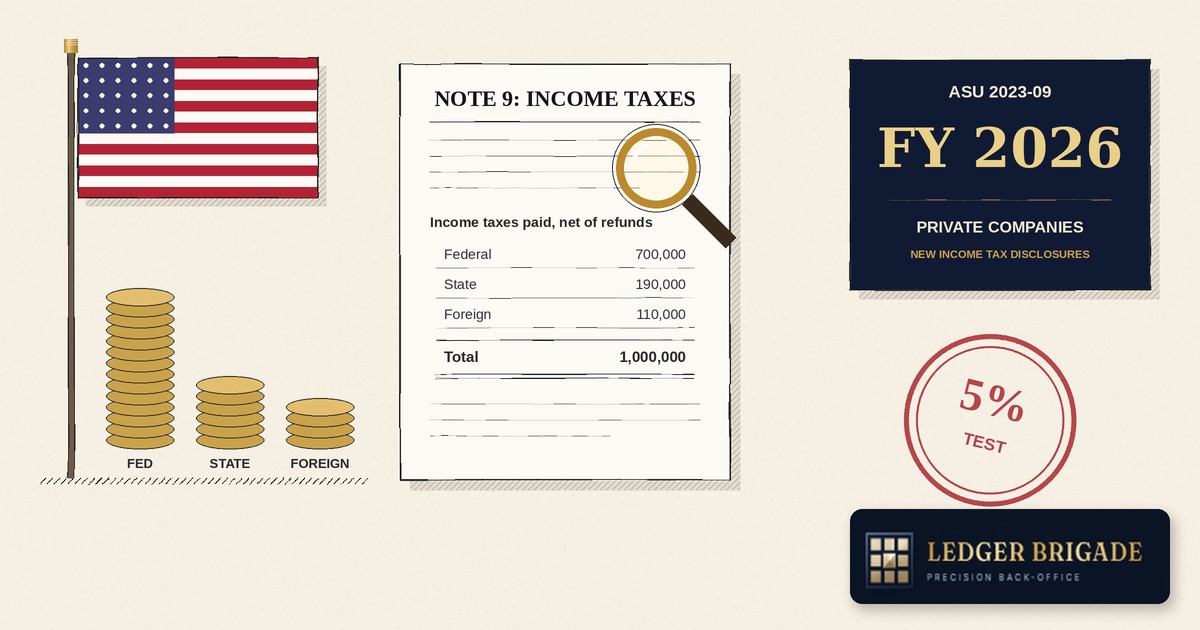
If your company is privately held and prepares US GAAP financial statements, your income tax note is about to change. ASU 2023-09, Improvements to Income Tax Disclosures, which public companies adopted last year, now applies to private companies for annual periods beginning after 15 December 2025. For a calendar-year company, that means the 2026 financial statements you will issue in 2027: the ones your team is preparing right now.
The good news: private companies do not have to produce the detailed numerical rate reconciliation table that public companies must. The catch: every entity now has to show where its income taxes were actually paid, and the data for that sits in payment records, not in the tax provision. Most teams need to start collecting it before year-end.
Who is affected? Every entity that applies ASC 740 (Income Taxes): C corporations, and also not-for-profits, partnerships and S corporations to the extent they pay income taxes at the entity level (more on pass-through entities below).
Transition: apply it prospectively (to the new year only); restating earlier years is allowed but not required. Early adoption is permitted for financial statements not yet issued or made available for issuance.
At a glance: what changes for public and private companies
| Requirement | Public business entities | Private companies |
|---|---|---|
| Income taxes paid, split federal / state / foreign (net of refunds) | Required | Required |
| Income taxes paid to each jurisdiction that is 5% or more of the total | Required | Required |
| Pre-tax income split domestic / foreign | Required | Required |
| Income tax expense split federal / state / foreign | Required | Required |
| Rate reconciliation | Table in dollars and percentages, eight set categories, 5% threshold | Narrative only: the nature and effect of the significant reconciling items and jurisdictions |
| Range of reasonably possible change in unrecognized tax benefits within 12 months | Removed | Removed |
1. Income taxes paid: the disclosure that needs new data
For each annual period, every entity must disclose (ASC 740-10-50-22 and 50-23):
- the amount of income taxes paid, net of refunds received, split into federal, state and foreign; and
- the amount paid to each individual jurisdiction where income taxes paid (net of refunds) are 5% or more of the total. A jurisdiction can be a country, a state or a local territory.
Five details that matter in practice:
- It is cash, not expense. The figure is what was actually paid in the year: estimated payments, extension payments and payments for earlier years, less refunds received. It will not match the tax expense in the income statement, and it is not meant to.
- Net of refunds, jurisdiction by jurisdiction. The FASB's basis for conclusions says to compare the absolute value of each jurisdiction's net payment (or net refund) with the absolute value of the total when applying the 5% test (paragraph BC70).
- Annual only, and no comparative history required by jurisdiction. The jurisdiction breakdown is needed for the current year; the FASB decided not to require jurisdiction comparatives for prior years (paragraph BC74).
- Only income taxes. Sales and use tax, payroll taxes and property taxes stay out. So do taxes that are not based on income, which is why the pass-through question below matters. Watch foreign withholding taxes too: a tax your company withholds from dividends it pays to its owners is generally the owners' tax, not yours (ASC 740-10-15-4(b) sets the conditions). Tax withheld abroad from payments your company receives, such as royalties, is commonly treated as the company's own income tax, but ASC 740 gives no explicit rule for recipients, so decide and document your policy.
- Materiality still applies. The FASB says an immaterial amount need not be shown separately, even if it crosses the 5% line.
Worked example
A fictional calendar-year manufacturer, illustrative figures only. Midwest Components Inc., a privately held C corporation, made these income tax payments in 2026:
| Jurisdiction | Paid in 2026 (net of refunds) | 5% or more of total? |
|---|---|---|
| US federal (2026 estimates plus the 2025 balance due) | $700,000 | Yes |
| Illinois | $120,000 | Yes |
| California | $55,000 | Yes |
| Indiana | $18,000 | No |
| Wisconsin | $9,000 | No |
| Michigan (refund received) | ($12,000) | No (absolute value $12,000) |
| Canada | $85,000 | Yes |
| Mexico | $25,000 | No |
| Total | $1,000,000 | 5% threshold = $50,000 |
So the company discloses federal, state and foreign totals, and separately names the four jurisdictions at or above $50,000:
| Income taxes paid, net of refunds, 2026 | Amount |
|---|---|
| Federal | $700,000 |
| State: Illinois | $120,000 |
| California | $55,000 |
| Other states | $15,000 |
| Total state | $190,000 |
| Foreign: Canada | $85,000 |
| Other foreign | $25,000 |
| Total foreign | $110,000 |
| Total income taxes paid, net of refunds | $1,000,000 |
Notice the Michigan refund: it reduces "Other states" ($18,000 + $9,000 minus $12,000 = $15,000). Netting refunds by jurisdiction like this is exactly why the data must be collected payment by payment, not from the year-end provision.
2. Two more splits that now apply to everyone
ASU 2023-09 also requires all entities to disclose each year:
- income (or loss) before income tax, split between domestic and foreign (ASC 740-10-50-10A); and
- income tax expense (or benefit) from continuing operations, split into federal, state and foreign (ASC 740-10-50-10B). Taxes that the home country charges on foreign earnings stay in the home-country figure.
Public companies already gave these under SEC rules; for most private companies they are new. Unlike the payments disclosure, these come straight from the tax provision, so the work is mainly in mapping the provision by jurisdiction.
3. The rate reconciliation: a narrative, not a table
Public companies must now present a detailed table in both dollars and percentages. Private companies do not. Instead, ASC 740-10-50-13 requires a qualitative description of the nature and effect of the significant reconciling items, using the same eight categories public companies use, and of the individual jurisdictions that cause a significant gap between the statutory rate (21% federal) and the effective rate.
The eight categories are: state and local income tax, net of federal (national) income tax effect; foreign tax effects; the effect of changes in tax laws or rates enacted in the current period; the effect of cross-border tax laws; tax credits; changes in valuation allowances; nontaxable or nondeductible items; and changes in unrecognized tax benefits.
Sample wording for Midwest Components (illustrative):
The Company's effective income tax rate for 2026 differs from the US federal statutory rate of 21% primarily because of state income taxes and foreign operations. State income taxes, mainly in Illinois and California, increased the effective rate. Operations in Canada, where profits are taxed at a higher combined rate than in the United States, also increased the effective rate. Federal research and development tax credits decreased the effective rate.
A private company may still include a numerical table if it believes that gives readers better information; the FASB said so expressly. Lenders of larger private companies sometimes ask for one.
4. What you can delete
Two older disclosures are removed for all entities:
- the nature and estimated range of a reasonably possible change in unrecognized tax benefits in the next 12 months (or a statement that an estimate cannot be made). The FASB reminds preparers that the general risks and uncertainties disclosures in ASC 275 may still require similar information in some cases;
- the cumulative amount of each type of temporary difference when a deferred tax liability is not recognized for investments in subsidiaries or corporate joint ventures.
Unchanged for private companies: you may still list the types of significant temporary differences and carryforwards without giving the tax effect of each (ASC 740-10-50-8).
5. Partnerships, S corporations and the PTET question
Many US private businesses are partnerships, LLCs taxed as partnerships, or S corporations. Their owners, not the business, normally pay the income tax, so their financial statements usually show little or no income tax. Does ASU 2023-09 affect them?
Only to the extent the entity itself pays an income tax that ASC 740 covers. Two situations come up often:
- Elective pass-through entity taxes (PTET). Many states let partnerships and S corporations elect to pay state income tax at the entity level, so the owners get a credit or an exclusion. Whether that payment is an income tax of the entity (accounted for under ASC 740) or a payment on behalf of the owners (treated like a distribution) is a judgment made state by state, based on how each state's law works. Practitioners have reached both conclusions for different regimes, usually working from the codification's own examples on whether a tax is attributable to the entity or to its owners (ASC 740-10-55-226 through 55-228, Examples 35 to 37).
- Mandatory entity-level taxes. Some states tax pass-through entities on their income directly; Illinois's personal property replacement income tax on partnerships and S corporations is a common example. These are more often within ASC 740.
Why it matters now: if you conclude that a PTET or similar tax is the entity's income tax, its payments belong in the new income taxes paid disclosure, broken down by state, and the 5% test applies. If you conclude that it is a transaction with owners, it stays out. Either way, write the conclusion down, state by state, before the auditors ask.
6. Your year-end checklist
- Confirm your first year. The rules apply to annual periods beginning after 15 December 2025: calendar 2026 for most companies, or the year starting 1 July 2026 for a June year-end.
- List every jurisdiction where the company pays income tax: federal, each state and city, and each foreign country.
- Build a payments log for 2026 by jurisdiction: date, amount, tax year it relates to, and any refunds received. Tie it to bank statements and to payment confirmations (IRS EFTPS, state portals, foreign tax receipts). If payments are buried in one "taxes paid" account, split them now, before the year closes.
- Map the tax provision into federal, state and foreign expense, and pre-tax income into domestic and foreign.
- Draft the rate narrative: which of the eight categories and which jurisdictions move your effective rate away from 21%.
- Decide and document whether each state PTET or entity-level tax is the entity's income tax.
- Remove the deleted disclosures, after checking whether ASC 275 still calls for anything similar.
- Update your note template and disclosure checklist, and walk your auditors and key lenders through the new format early.
Sample note (illustrative)
Income taxes paid, net of refunds received, were $1,000,000 for the year ended December 31, 2026, comprising federal $700,000, state $190,000 and foreign $110,000. Income taxes paid to jurisdictions equal to or greater than 5% of the total were: US federal $700,000; Illinois $120,000; Canada $85,000; and California $55,000.
Frequently asked questions
Does ASU 2023-09 change how we calculate our tax expense?
No. It changes only what you disclose. The tax provision itself is calculated as before.
Do we have to restate 2025 in the new format?
No. Prospective application is the default; showing earlier years in the new format is optional.
Do we need these disclosures in interim or quarterly statements?
No. The income taxes paid disclosures are annual only.
Does a not-for-profit have to comply?
Only if it applies ASC 740, typically because it pays tax on unrelated business income, and subject to materiality.
Can we still give a numerical rate reconciliation?
Yes. It is optional for private companies, and some lenders prefer it.
Need help?
Ledger Brigade's US team, overseen by qualified US CPAs, builds income tax payment logs by jurisdiction, maps tax provisions, and drafts the new disclosures for private companies before their auditors arrive. Email hello@ledgerbrigade.com or book a briefing.
Has your team started collecting income tax payments by jurisdiction yet? Tell us in the comments.
Disclaimer: General information, not accounting, tax or legal advice. Stated as at 23 October 2026. Confirm the treatment of your own facts with your auditors and advisers.
Sources
- FASB, Accounting Standards Update 2023-09, Income Taxes (Topic 740): Improvements to Income Tax Disclosures, including ASC 740-10-50-8, 50-10A, 50-10B, 50-13, 50-15, 50-22, 50-23, 740-30-50-2 and transition paragraph 740-10-65-9, and the Basis for Conclusions.
- PwC, FASB issues guidance on income tax disclosures.
- BDO, State pass-through entity tax elections: weighing the pros and cons; The Tax Adviser, PTETs: orchestrating ASC 740 compliance.
Comments (0)
Be the first to comment.
Leave a comment