By Abhinav Chhabra, Ledger Brigade | 24 October 2026
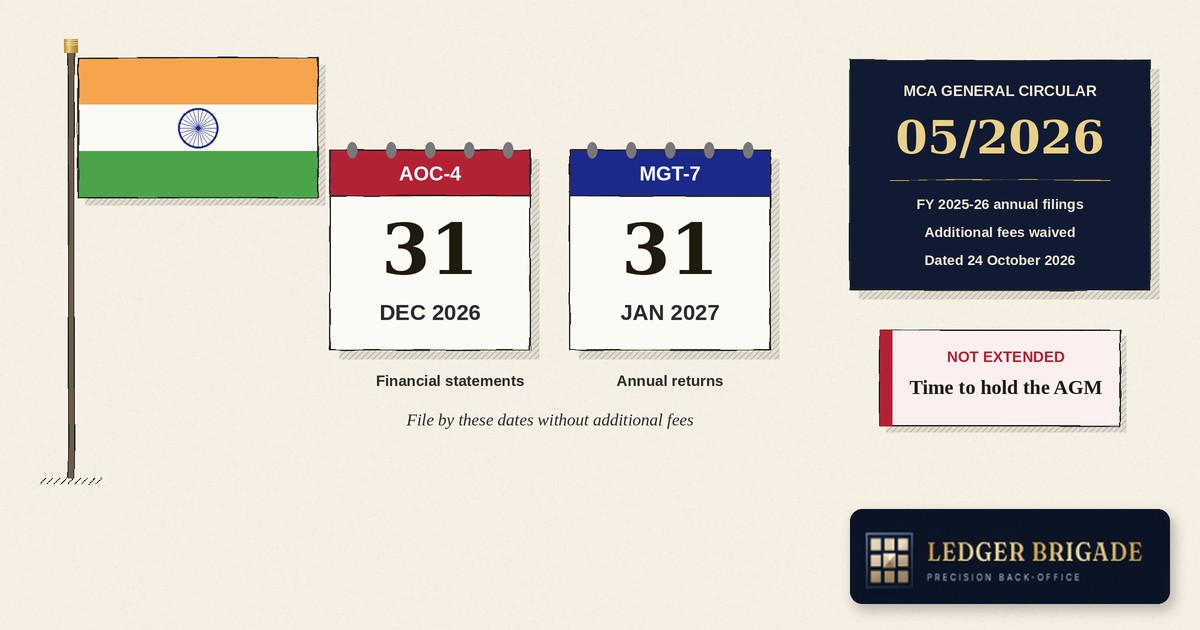
Relief for companies, six days before the first deadline. On 24 October 2026 the Ministry of Corporate Affairs issued General Circular No. 05/2026, allowing companies to file their annual financial statements and annual returns for FY 2025-26 after the dates set by the Companies Act, without paying additional fees.
For most private companies, that is worth ₹12,500 to ₹25,000 in fees avoided, and more for groups. This article sets out exactly what the circular says, how much it saves in each situation, and the traps that can take the saving away.
The new dates at a glance
| Form | What it is | Normal due date (AGM on 30 September 2026) | Can now be filed without additional fees until |
|---|---|---|---|
| AOC-4, AOC-4 (CFS), AOC-4 (XBRL), AOC-4 NBFC (Ind AS), AOC-4 CFS NBFC (Ind AS) | Financial statements (section 137) | 30 October 2026 (30 days after the AGM) | 31 December 2026 |
| MGT-7 and MGT-7A | Annual return (section 92) | 29 November 2026 (60 days after the AGM) | 31 January 2027 |
MGT-7A is the shorter annual return used by one person companies and small companies.
What the circular says
The circular is short, and every paragraph matters:
- Paragraph 2 allows companies to file the five AOC-4 forms for FY 2025-26 up to 31 December 2026, and MGT-7 and MGT-7A up to 31 January 2027, "without payment of additional fees".
- Paragraph 3 makes clear that it does not extend the time for holding AGMs, and that companies which missed the statutory timelines "shall be liable under the relevant provisions of the Act".
- Paragraph 4 says that a filing made after the relaxation ends attracts all fees, including additional fees, from the date the filing was actually due under the Act.
The circular followed a representation from the Institute of Company Secretaries of India (ICSI) dated 9 October 2026, which pointed to the load on the MCA21 V3 portal.
How much companies save
The rule that is being waived: under the Companies (Registration Offices and Fees) Rules, 2014, a late AOC-4 or MGT-7 carries an additional fee of ₹100 for every day of delay, for each form, with no upper limit. It starts the day after the due date and stops on the day the form is filed. The normal filing fee (which depends on the company's share capital) is still payable; only the additional fee is waived.
The saving depends on your AGM date
The earlier your AGM, the earlier your forms fell due, and the more additional fee the circular wipes out. These are the maximum savings for a company that files on the last day of each window (31 December 2026 for AOC-4, 31 January 2027 for MGT-7):
| AGM held on | AOC-4 was due | AOC-4 fee waived | MGT-7 was due | MGT-7 fee waived | Total saving |
|---|---|---|---|---|---|
| 31 July 2026 | 30 August 2026 | ₹12,300 (123 days) | 29 September 2026 | ₹12,400 (124 days) | ₹24,700 |
| 31 August 2026 | 30 September 2026 | ₹9,200 (92 days) | 30 October 2026 | ₹9,300 (93 days) | ₹18,500 |
| 15 September 2026 | 15 October 2026 | ₹7,700 (77 days) | 14 November 2026 | ₹7,800 (78 days) | ₹15,500 |
| 25 September 2026 | 25 October 2026 | ₹6,700 (67 days) | 24 November 2026 | ₹6,800 (68 days) | ₹13,500 |
| 30 September 2026 | 30 October 2026 | ₹6,200 (62 days) | 29 November 2026 | ₹6,300 (63 days) | ₹12,500 |
Good news for late filers: the relief is not limited to forms that were still within time on 24 October. A company whose AOC-4 fell due in August or September, and which has not filed yet, can now file up to 31 December 2026 without the fee that has been building up since then.
Worked examples
Illustrative figures for companies with a 31 March year-end.
1. A typical private limited company. AGM on 30 September 2026. It files AOC-4 on 20 December 2026 and MGT-7 on 20 January 2027.
- Without the circular: AOC-4 51 days late (₹5,100) and MGT-7 52 days late (₹5,200), a total of ₹10,300.
- With the circular: ₹0 in additional fees.
2. A holding company with a subsidiary. AGM on 30 September 2026. It files three forms: AOC-4 (standalone), AOC-4 (CFS) for the consolidated accounts, and MGT-7, each on the last day of its window.
- AOC-4 (CFS) is a separate e-form with its own fees, so its additional fee runs separately from the standalone AOC-4.
- Fees waived: ₹6,200 + ₹6,200 + ₹6,300 = ₹18,700.
3. A one person company (OPC). An OPC does not hold an AGM; it files AOC-4 within 180 days of the year-end, so its AOC-4 was due on 27 September 2026.
- Filing AOC-4 on 31 December 2026 saves ₹9,500 (95 days).
- The MGT-7A due date for an OPC is not settled, because section 92(4) counts 60 days from an AGM that an OPC never holds. Practitioners use either 29 November 2026 (60 days from 30 September) or 26 November 2026 (60 days from the end of the 180-day accounts period, or earlier if the accounts were adopted earlier). Filing MGT-7A on 31 January 2027 therefore saves ₹6,300 to ₹6,600.
- Total: about ₹15,800 to ₹16,100.
4. A practice handling many companies. A firm that files for 50 client companies, all with 30 September AGMs, avoids up to ₹6.25 lakh of additional fees across its clients.
The trap: miss the new date by one day
The relief is a window, not a new due date. Paragraph 4 of the circular brings the full additional fee back, counted from the original due date, for anything filed after the window closes.
For a company with a 30 September AGM:
| Filed on | Additional fee |
|---|---|
| AOC-4 on 31 December 2026 | ₹0 |
| AOC-4 on 1 January 2027 | ₹6,300 (63 days from 30 October) |
| MGT-7 on 31 January 2027 | ₹0 |
| MGT-7 on 1 February 2027 | ₹6,400 (64 days from 29 November) |
One day late costs more than the whole saving. And the additional fee is not the only cost of a late filing: the Companies Act also provides separate penalties for failing to file financial statements (section 137(3)) and the annual return (section 92(5)), starting at ₹10,000 for the company and for each officer in default. Treat 31 December and 31 January as hard deadlines, and remember that the MCA21 portal slows down in the last week of every filing window.
Already filed and paid the additional fee?
The circular does not provide for refunds of additional fees already paid on FY 2025-26 forms, so do not plan on one.
Four things the circular does NOT do
- It does not extend the time for holding the AGM. A company that did not hold its AGM by 30 September 2026 (or by an extended date granted by the Registrar) is still in default.
- It does not cover every annual form. Only the five AOC-4 forms and MGT-7 / MGT-7A are listed. ADT-1 (auditor appointment) and DIR-12 are not mentioned, although ICSI had asked for them too.
- It does not cover LLPs. LLP Form 8 (statement of account and solvency), due on 30 October 2026, is not part of this circular.
- It does not waive the normal filing fee. Only the additional fee for delay is relaxed.
What to do now
- Aim for mid-December and mid-January. File AOC-4 by about 15 December and MGT-7 by about 15 January, leaving two weeks for portal problems, rejections and resubmissions.
- Check your AGM date. If the AGM was late or not held, speak to your advisers now: this circular does not cure that default.
- Check the forms the circular leaves out. ADT-1, DIR-12 and LLP Form 8 follow their own dates.
- Groups and practices: list every company and every form (including AOC-4 CFS), with its own window, and file the ones with the earliest AGMs first.
Need help?
Ledger Brigade files AOC-4 and MGT-7 for private limited companies and OPCs across Delhi NCR and India, with work reviewed by qualified CAs. Our MCA annual filing package (AOC-4 and MGT-7) is ₹5,999 a year, with government fees at actuals. Email hello@ledgerbrigade.com or book a briefing.
Has the V3 portal held up your filings this year? Tell us in the comments.
Disclaimer: General information, not legal advice. Figures are illustrative and assume a 31 March year-end. Stated as at 24 October 2026.
Source
Ministry of Corporate Affairs, General Circular No. 05/2026 (File No. Policy-17/111/2022-CL-V-MCA), dated 24 October 2026, "Relaxation of additional fees and extension of time for filing of Financial Statements and Annual Returns under the Companies Act, 2013"; Companies Act, 2013, sections 92 and 137; Companies (Registration Offices and Fees) Rules, 2014.
Comments (0)
Be the first to comment.
Leave a comment