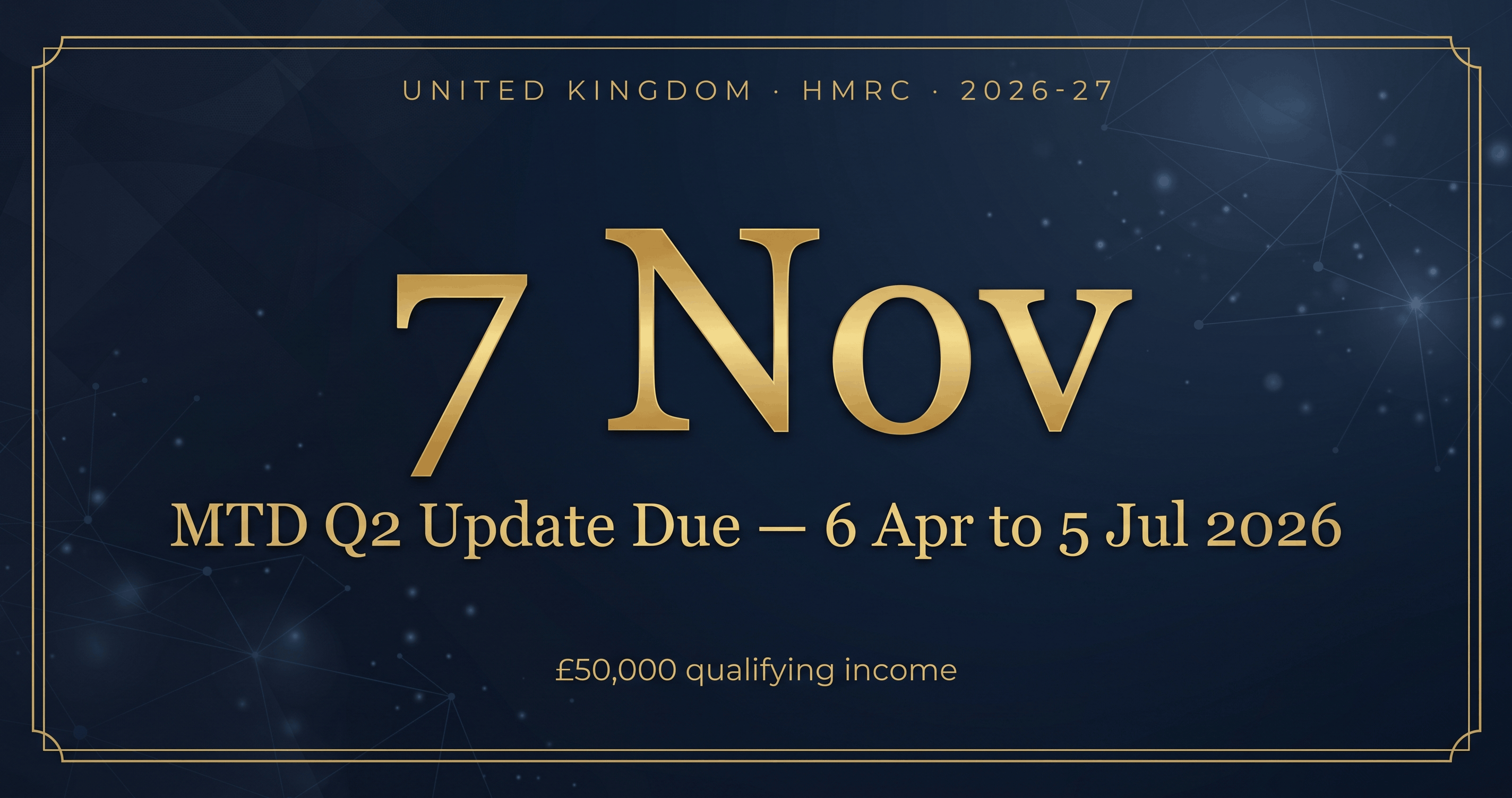
The second quarter of Making Tax Digital for Income Tax (MTD for IT) closed on 5 October 2026. If you are a sole trader or landlord with qualifying income over £50,000 and you are in MTD, your Q2 quarterly update must be submitted to HMRC by 7 November 2026.
Three errors account for the majority of late or incorrect submissions in the MTD cohort. Each of them is straightforward to prevent, and surprisingly common.
What a Quarterly Update Actually Contains
An MTD quarterly update is not a tax return. It is a submission of cumulative income and expenses for the year to date, broken down by the property-and-business income categories HMRC specifies. Q2 covers the period 6 April to 5 October, cumulatively, not just the quarter.
This is where the first common error occurs: teams submitting only the quarter's figures rather than the year-to-date totals. The update is cumulative. Q2's figures include Q1.
Separate Updates for Each Income Source
If you have both a trade and a rental property, or multiple rental properties that are not consolidated, each income source requires its own quarterly update. A single submission covering all income sources is not valid.
This matters at Q2 specifically because it is the first update where most agents have accumulated enough transactions to see whether their client's bookkeeping has been properly segregated. If it hasn't, a Q2 submission that blends trade and property income will need to be corrected, and HMRC's correction process for MTD updates is not instant.
Penalty Points and the "No Points = Optional" Mistake
MTD for IT uses a points-based penalty system. You accrue a point for each missed quarterly update, and once your points total reaches the threshold for your filing frequency, a financial penalty applies. Points reset after a sustained period of compliance.
A misconception that circulates is that because you haven't hit the penalty threshold yet, missing an update is acceptable. It is not. Each missed update is a point accrued, a compliance record mark, and for agents, a risk of professional censure. The points system is how HMRC manages enforcement. It is not a grace scheme.
What Changes in April 2027
From 6 April 2027, MTD for IT extends to sole traders and landlords with qualifying income over £30,000. If you have clients currently below the £50,000 threshold but above £30,000, they will be mandated within the next two tax years. Q2 2026 is a practical opportunity to begin the process of moving their records to MTD-compatible software before the mandate hits.
HMRC has also confirmed it is monitoring compliance closely in the first mandatory cohort. Late submissions in the current year carry greater weight in the compliance profile they are building for \this group.
Checklist for the 7 November Deadline
- Confirm your software has connected to HMRC's API, an authorisation token expiry is the single most common technical reason for a failed submission.
- Check that your figures are cumulative (6 April to 5 October), not just July to October.
- Submit a separate update for each income source if your client has multiple qualifying trades or properties.
- Retain evidence of submission confirmation from your MTD-compatible software for each update.
General information only. MTD rules are subject to HMRC guidance and legislative updates. Consult your tax adviser for guidance specific to your situation.
Comments (0)
Be the first to comment.
Leave a comment