By Abhinav Chhabra, Ledger Brigade | 22 October 2026
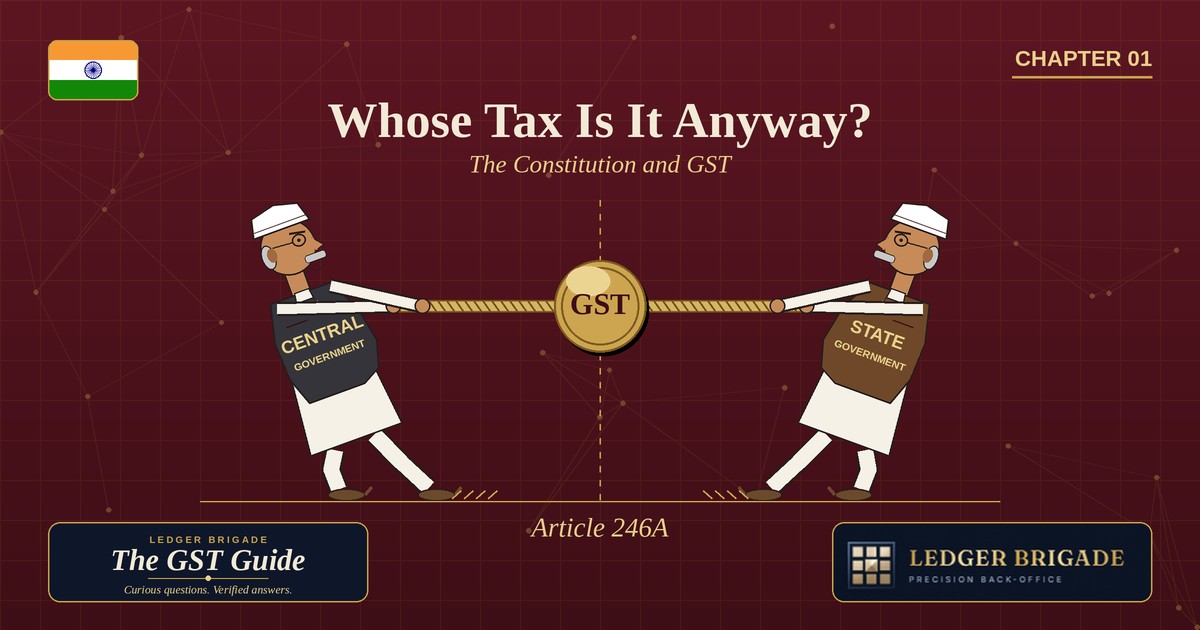
India's Constitution has three neat lists of who may tax what: one for the Centre, one for the States, one shared. GST is the biggest tax in the country, so it must sit on one of them. Right?
Wrong, and the reason why is one of the cleverest pieces of drafting in the Constitution. This chapter answers eight questions that most textbooks skip. Try answering each one yourself before you read on.
1. Which list does GST fall under: Union, State or Concurrent?
None of them. GST has no entry in any of the three lists. It has an article of its own.
Before 2016, every tax power came from an entry in the Seventh Schedule, read with Article 246. The Centre taxed services (entry 92C of the Union List) and manufacture (excise, entry 84). The States taxed sales (entry 54 of the State List), entry of goods into a local area (entry 52) and entertainment (entry 62). Each side had its own fenced field.
The Constitution (One Hundred and First Amendment) Act, 2016 did not add a GST entry to any list. Instead it inserted a brand-new Article 246A, which opens like this:
"246A. (1) Notwithstanding anything contained in articles 246 and 254, Parliament, and, subject to clause (2), the Legislature of every State, have power to make laws with respect to goods and services tax imposed by the Union or by such State."
Then it cleared the ground. Entries 92 and 92C were omitted from the Union List, entry 84 was cut down to petroleum products and tobacco, entries 52 and 55 were omitted from the State List, and entries 54 and 62 were rewritten.
The Supreme Court put it neatly in VKC Footsteps: Article 246A defines both the source of power and the field of legislation, "obviating the need to travel to the Seventh Schedule."
So the honest answer to the quiz question is: none, because GST was given an article instead of an entry.
2. Why not simply put GST in the Concurrent List?
It sounds like the obvious home for a tax that both the Centre and the States collect. But the Concurrent List comes with a tie-breaker, and the tie-breaker always favours the Centre.
Article 254(1) says that where a State law is repugnant to a central law on a Concurrent List matter, the central law prevails and the State law, "to the extent of the repugnancy, be void." (A State can escape this only with the President's assent under Article 254(2), and even then Parliament can override it later.)
A GST in the Concurrent List would therefore have meant this: whenever the Centre's GST law and a State's GST law disagreed, the Centre would win. For States handing over their biggest sources of revenue, that would have been a hard bargain.
The Government said as much when Parliament's Select Committee examined the Bill in 2015. Its explanation of the GST Council's voting design, recorded in the Committee's report and quoted by the Supreme Court (paragraph 41) in Mohit Minerals, reads:
"Presently, in the concurrent list, in case of any difference between Central and State legislation, the Central legislation prevails. The present weightage of votes in the GST Council would ensure that neither the Centre nor the States are able to take a decision without the support of the other. In other words both would enjoy a veto."
That is why Article 246A begins with "Notwithstanding anything contained in articles 246 and 254". Those few words switch off the Concurrent List's tie-breaker for GST.
A bonus fact for the curious: the Supreme Court has observed that the Concurrent List is no home for taxes at all. In Mohit Minerals it said (paragraph 25): "The concurrent list does not include any entry related to taxation." Putting GST there would have broken new ground as well as handing the Centre the last word.
3. So if the Centre and a State disagree on GST, who wins?
Nobody, at least not by constitutional rank. Article 246A gives both sides power at the same time, and the Constitution simply does not say whose GST law prevails if they clash.
The Supreme Court spelt this out in paragraph 30 of Mohit Minerals:
"Unlike Article 254 which stipulates that the law made by Parliament on a subject in the Concurrent list shall prevail over conflicting laws made by the State legislature, the constitutional design of Article 246A does not stipulate the manner in which such inconsistency between the laws made by Parliament and the State legislature on GST can be resolved."
The Court calls this a "simultaneous power", to distinguish it from ordinary concurrent power. Earlier, in VKC Footsteps, it had described Article 246A as embodying "the constitutional principle of simultaneous levy as distinct from the principle of concurrence."
So how does the system avoid chaos? Not through a referee, but through a forum where both sides must agree: the GST Council (questions 5 and 6).
4. If the power is equal, why can only the Centre tax a sale from Delhi to Mumbai?
Because the equality has one deliberate exception. Article 246A(2) says:
"Parliament has exclusive power to make laws with respect to goods and services tax where the supply of goods, or of services, or both takes place in the course of inter-State trade or commerce."
Within a State, both the Centre and that State levy GST side by side: CGST and SGST. Across a State border, only Parliament may legislate, which is where IGST comes from.
That does not mean the Centre keeps the money. Article 269A says inter-State GST "shall be levied and collected by the Government of India and such tax shall be apportioned between the Union and the States", in the manner Parliament provides by law on the GST Council's recommendations.
Now a puzzle: a container of machine parts arrives at Mumbai port from Germany. It never crossed a State border, so is the GST on it CGST plus SGST? No, it is IGST. The Explanation to Article 269A(1) deems a supply "in the course of import into the territory of India" to be a supply in the course of inter-State trade or commerce. Legally, Germany behaves like another State.
5. Who really controls the GST Council?
Neither side on its own. The arithmetic in Article 279A(9) makes sure of it. Every decision needs "a majority of not less than three-fourths of the weighted votes of the members present and voting", and the weights are fixed:
"(a) the vote of the Central Government shall have a weightage of one-third of the total votes cast, and (b) the votes of all the State Governments taken together shall have a weightage of two-thirds of the total votes cast, in that meeting."
| Who votes yes | Share of the weighted vote | Is that three-fourths? |
|---|---|---|
| The Centre alone | 33.3% | No |
| Every State together, Centre against | 66.7% | No |
| The Centre plus States carrying at least 62.5% of the States' share | 75% or more | Yes |
So the Centre can block any decision, and so can the States, if enough of them vote together. Nothing passes unless both sides agree. That is the "both would enjoy a veto" the Government described to the Select Committee in 2015, adding that the Centre "would require support of 20 States/Union Territories to get a resolution passed." (That count reflects the number of States and Union Territories with a vote at the time.)
Try this one at a dinner party: a GST rate cut that the Centre wants and every single State opposes cannot pass. Neither can one that every State wants and the Centre opposes.
6. Is the GST Council's word final?
No, and this surprises most people, including many professionals. In Union of India v. Mohit Minerals Pvt. Ltd. (Civil Appeal No. 1390 of 2022, decided on 19 May 2022), the Supreme Court concluded (paragraph 148):
"The recommendations of the GST Council are not binding on the Union and States"
The Court's reasoning ties back to the earlier questions. Article 246A gives Parliament and the State legislatures simultaneous power, and nothing in Article 246A makes it subject to Article 279A. In the Court's words (paragraph 148(i)(b)):
"Neither does Article 279A begin with a non-obstante clause nor does Article 246A state that it is subject to the provisions of Article 279A."
The Council's recommendations, it said, "are the product of a collaborative dialogue involving the Union and States. They are recommendatory in nature."
So the Council is the forum where agreement is built, not a super-legislature. That does not make it toothless: a government that ignored the Council would be breaking the very bargain that persuaded both sides to share the tax. But legally, the last word on a GST law belongs to Parliament and the State legislatures.
7. Petrol is outside GST, isn't it?
Legally, petrol is inside GST. It is switched off. The thing that is truly outside GST is alcohol.
Start with the definition the amendment added to the Constitution, Article 366(12A):
"'goods and services tax' means any tax on supply of goods, or services or both except taxes on the supply of the alcoholic liquor for human consumption"
Only one exception is written into the definition: alcoholic liquor for human consumption. Petrol is not excluded at all.
Instead, the Constitution puts five petroleum products on hold. Article 279A(5) says the GST Council "shall recommend the date on which the goods and services tax be levied on petroleum crude, high speed diesel, motor spirit (commonly known as petrol), natural gas and aviation turbine fuel." And the Explanation to Article 246A says that, for these products, the article takes effect "from the date recommended by the Goods and Services Tax Council."
Until that date, the old taxes carry on: central excise on these fuels stays in the Union List (entry 84), and State taxes on their sale stay in the State List (entry 54, which also keeps alcohol with the States).
At the time of writing, no such date has been recommended, which is why your fuel bill still carries central excise and State VAT rather than GST. But notice the difference: bringing petrol into GST needs only a Council recommendation, while bringing alcohol into GST would need another constitutional amendment.
8. Why did the States agree to give up their taxes at all?
They gave up a lot: VAT on most goods, entry tax, entertainment tax collected by the State, and more. What they got in return was written into the amendment itself.
First, a promise of compensation. Section 18 of the Constitution (One Hundred and First Amendment) Act, 2016 says:
"Parliament shall, by law, on the recommendation of the Goods and Services Tax Council, provide for compensation to the States for loss of revenue arising on account of implementation of the goods and services tax for a period of five years."
GST began on 1 July 2017, so this guarantee covered its first five years.
Second, a seat that cannot be taken away easily. The amendment added Article 279A to the proviso to Article 368(2). That proviso lists the parts of the Constitution that can be amended only if the legislatures of at least half the States ratify the change. In plain terms: the Centre cannot rewrite the GST Council's rules on its own, even with a large majority in Parliament.
Third, a veto on every Council decision (question 5), and a dispute mechanism: Article 279A(11) requires the Council to "establish a mechanism to adjudicate any dispute" between the Centre and the States, or between States, arising out of its recommendations or their implementation.
In practice
For a business, the constitutional design shows up every day: CGST plus SGST on a sale within your State, IGST on a sale to another State or on an import, and no GST at all on petrol you buy for your vehicle. Registering for GST? Our free GST consent letter generator prepares the owner's consent letter in English or Hindi, and our team can handle your registration.
For business owners: our companion article, Do You Need GST Registration?, turns the law into plain-English rules and Delhi NCR examples.
Next in the guide: Chapter 2, what exactly is a "supply"? (coming soon)
Sources
Every quotation in this chapter was checked against these primary texts:
- The Constitution (One Hundred and First Amendment) Act, 2016, Gazette of India, 8 September 2016 (GST Council copy): Articles 246A, 269A, 279A and 366(12A), section 17 (Seventh Schedule) and section 18 (compensation).
- Article 254, Constitution of India (Indian Kanoon).
- Union of India & Anr. v. M/s Mohit Minerals Pvt. Ltd., Supreme Court of India, Civil Appeal No. 1390 of 2022, judgment of 19 May 2022 (Dr D.Y. Chandrachud, Surya Kant and Vikram Nath, JJ.). Quotations checked against the official copy from the Supreme Court: Read the full judgment (PDF). Paragraphs quoted: 25, 30 and 148. It also quotes Union of India v. VKC Footsteps India Pvt. Ltd., (2022) 2 SCC 603, paragraph 52 (at paragraph 29), and the Rajya Sabha Select Committee's 2015 report on the Constitution (One Hundred and Twenty-Second Amendment) Bill, 2014, paragraphs 2.68 and 2.69 (at paragraph 41).
Law stated as at 22 October 2026. General information, not tax or legal advice.
Over to you: which answer surprised you most? Tell us in the comments.
Comments (0)
Be the first to comment.
Leave a comment