By Abhinav Chhabra, Ledger Brigade | 20 October 2026
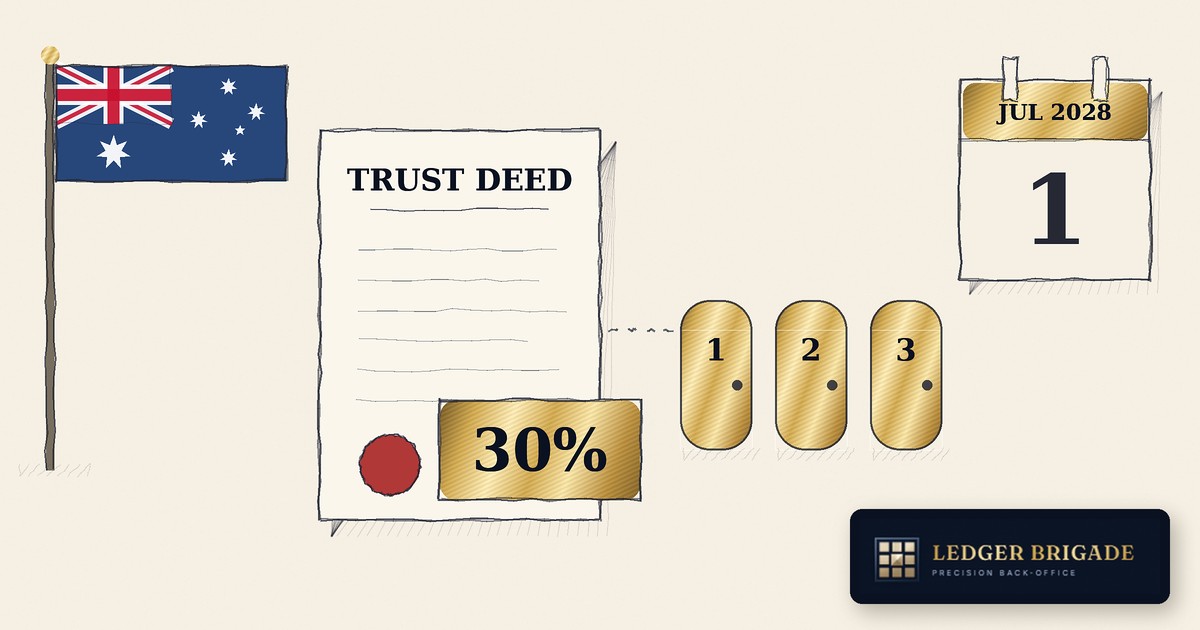
On 14 October 2026, the Government introduced the legislation for a 30% minimum tax on discretionary trusts, first announced in the May 2026 Budget. If you run a business, hold property or invest through a family trust, this is the week the proposal turned into a real bill with real dates.
It is not law yet. The Opposition has said it won't support the bills, so the Government needs crossbench support in the Senate, and the Greens have called for changes. The design could still move. But the dates in the bill are close enough that it's worth understanding now.
What changed
Two bills were introduced on 14 October:
- Treasury Laws Amendment (Tax Reform No. 3) Bill 2026, which contains the rules (along with further negative gearing and CGT changes); and
- Income Tax Rates Amendment (Minimum Tax on Discretionary Trusts) Bill 2026, which sets the rate.
Under the bills, the trustee of a discretionary trust would pay tax so that the trust's income bears at least 30%. Where no tax is otherwise paid at trustee level, the trustee pays 30%. Individual (non-corporate) beneficiaries then get a non-refundable tax offset for their share. Corporate beneficiaries get no offset.
The bills were referred to the Senate Economics Legislation Committee on 15 October, with its report due by 13 November 2026. Submissions reportedly close on 29 October, with hearings on 5 and 6 November.
The numbers at a glance
| Item | What the bill proposes |
|---|---|
| Minimum tax rate | 30% of the trust's "minimum tax income" |
| Start date | Income years starting on or after 1 July 2028 |
| Rollover relief to restructure | From 1 July 2027, for three years (to 30 June 2030) |
| Excluded trusts | Fixed trusts, charitable trusts, special disability trusts, super funds, deceased estates |
| Excluded income | Primary production income, certain income of vulnerable minors, genuine testamentary trust income, distributions to charities and DGRs |
| Offset for individual beneficiaries | 30% of their share, non-refundable |
| Offset for company beneficiaries | None |
| Franking credits | Applied against the trustee's minimum tax; any excess refunded to the trustee |
| Government's estimate of impact | More than 90% of small businesses not affected in any given year |
What it means for businesses
Treasury figures put the number of active small businesses operating through a discretionary trust at around 350,000. Most family trusts that distribute mainly to adults on high marginal rates will see little change in the total tax paid. The main difference is timing, because the trustee pays first.
The groups more likely to pay more are:
- Adult family members on low incomes. Today, distributing to an adult child at university or a spouse with little other income can mean little or no tax on that share. Under the bill, the trustee pays 30% up front, and the beneficiary's offset can only reduce their own tax. It can't create a refund.
- Bucket companies. Distributing to a company beneficiary is common because company tax rates are below the top personal rate. Under the bill, the company gets no offset for the trustee's 30%, which makes this route much more expensive.
- Groups with several trusts. Each trust needs its own decision, and a trust distributing to another trust adds a layer of complexity.
Franking credits also stop flowing through to beneficiaries the way they do now.
Your three options (if it passes)
- Accept the minimum tax. You keep full discretion over who gets what each year, and pay at least 30% at trust level.
- Make the excluded election. The trust nominates beneficiaries and fixed percentages of income and capital that add up to 100%, then follows those percentages every year. The Government says this won't require a restructure or, it expects, state stamp duty. Under the draft law, the election can be made once, in the 2028–29 income year. Departing from the nominated shares revokes it, with the trustee taxed at the top rate for that year. The introduced bill adds a Commissioner's discretion for inadvertent errors.
- Restructure. Move the business or assets into a company, fixed trust or other structure using the rollover relief that would apply from 1 July 2027 to 30 June 2030. The rollover is a deferral, not an exemption. It doesn't cover GST, FBT or state duties, and it comes with a four-year clawback if discretion creeps back in.
You can't use both the rollover and the excluded election for the same trust.
Worked examples
These are simplified illustrations based on the bill as introduced. They aren't tax calculations for your situation.
Example 1: adult beneficiary at the top rate. A trust distributes $100,000 to a director already on the top marginal rate. The trustee pays $30,000. The director claims a $30,000 offset against their personal tax and pays the balance as usual. The total tax is broadly the same as today. The difference is that $30,000 leaves the trust earlier.
Example 2: adult student beneficiary. The trust distributes $20,000 to a 20-year-old university student with no other income. Today that share would typically attract little or no personal tax. Under the bill, the trustee pays $6,000, and because the offset is non-refundable, that $6,000 doesn't come back.
Example 3: bucket company. The trust distributes $100,000 to a family company. The trustee pays $30,000 and the company gets no offset, so the company's own tax on the distribution sits on top of it. This is why advisers expect bucket company strategies to be reconsidered.
Action checklist
- Don't restructure yet. The bill is before a Senate committee and could change. The rollover window doesn't open until 1 July 2027.
- Map your trust group. List every trust, its trustee, its deed date and who it distributes to.
- Pull three years of distribution history. Note who received what, especially low-income adults and companies.
- Check your trust deed. Can it support fixed nominations of income and capital if you choose the election?
- Keep the books clean, entity by entity. Separate ledgers, documented distribution resolutions by 30 June each year, and a reconciled loan account between trust, company and individuals will make modelling much cheaper.
- Budget for advice in 2027. Industry estimates of restructuring costs vary widely, so get a quote early.
- If you want your say, the Senate committee is reportedly taking submissions until 29 October.
Frequently asked questions
Is the 30% trust tax law now? No. The bills were introduced on 14 October 2026 and are before a Senate committee. They still need to pass both Houses.
When would it start? For income years starting on or after 1 July 2028. Rollover relief for restructuring would be available from 1 July 2027 for three years.
Does it apply to unit trusts? Trusts that meet the bill's new definition of a fixed trust are excluded. Some unit trusts give trustees discretion, so check whether yours meets the new test.
What about testamentary trusts and farming families? Genuine testamentary trusts set up under a will are excluded, though property injected after 7:30 pm AEST on 12 May 2026 may not be. Primary production income is excluded, but rent from merely holding farmland may not be.
Should we move everything into a company now? Not without modelling. Restructuring now could trigger CGT and stamp duty that the rollover, once available, may help defer. And the rules could still change.
Want a clear picture of your structure?
Ledger Brigade keeps the books for small businesses and family groups across Australia, so your accountant has clean, reconciled numbers to model these options. Email hello@ledgerbrigade.com or book a free diagnostic call. We'll review how your entities are set up in your books and what records you'll need. This is general guidance, not tax advice on your structure.
Is your business run through a family trust, a company, or both?
Disclaimer: This article is general information, not tax or legal advice. It describes legislation introduced to Parliament on 14 October 2026 that has not been passed and may change. Speak to a registered tax agent before acting.
Sources
- Treasurer's media release, "Tax reform for a fairer tax system", 14 October 2026: treasury.gov.au
- Parliament of Australia, Treasury Laws Amendment (Tax Reform No. 3) Bill 2026: aph.gov.au
- Parliament of Australia, Income Tax Rates Amendment (Minimum Tax on Discretionary Trusts) Bill 2026 (referred to committee, report due 13 November 2026): aph.gov.au
- Treasury, exposure draft explanatory materials (September 2026): treasury.gov.au
- PwC Australia, "Draft law for the 30% minimum tax on discretionary trusts": pwc.com.au
- Grant Thornton Australia, "Minimum 30 per cent tax on discretionary trusts: legislation now before Parliament": grantthornton.com.au
Comments (0)
Be the first to comment.
Leave a comment