By Abhinav Chhabra, Ledger Brigade | 23 October 2026
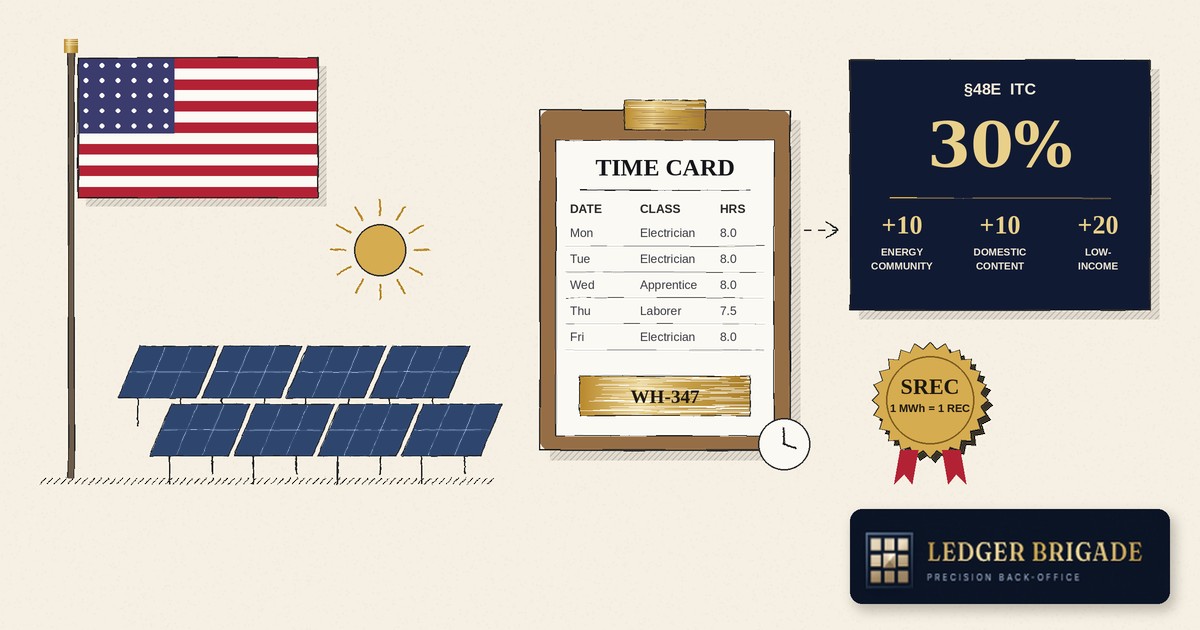
If you develop, install or own commercial solar in the US, 2026 is the year the rules got tighter and the paperwork got heavier. The federal credit can still be worth 30% of your project cost, and sometimes 40%, 50% or more. But only if you can prove it: when construction began, where the project sits, where the equipment came from, and what every worker on site was paid, hour by hour.
This guide covers the tax rules, the US GAAP accounting, the state incentives, and the payroll evidence (in ADP or on paper time cards) that an IRS examiner or a tax credit buyer will ask to see. Along the way it compares state incentives, from Illinois, New Jersey and Massachusetts to New York, California and Texas, and it ends with a fully worked project example.
Key dates at a glance
| Date | What it means |
|---|---|
| 31 December 2025 | Residential solar credit (section 25D) ended for homeowners |
| 1 January 2026 | Foreign entity ("material assistance") test applies to projects beginning construction from this date |
| 4 July 2026 | Last day to begin construction of a solar project and keep the longer completion window |
| 31 December 2027 | Solar projects that began construction after 4 July 2026 must be placed in service by this date |
| Up to 2030 | Projects that began construction by 4 July 2026 generally have four years to finish under the continuity safe harbor |
What changed: the One Big Beautiful Bill Act and what followed
The One Big Beautiful Bill Act (OBBBA), signed on 4 July 2025, kept the business solar credit but put an end date on it.
- Homeowners: the 30% residential credit under section 25D ended for systems placed in service after 31 December 2025.
- Businesses: the clean electricity investment credit under section 48E (the "ITC") survives for solar, but a project must either begin construction by 4 July 2026 or be placed in service by 31 December 2027. Projects that began construction in time generally keep a four-year window to finish (the continuity safe harbor), which can run into 2030.
- Foreign entities: new "prohibited foreign entity" rules stop certain foreign-linked taxpayers from claiming or buying credits, and projects that begin construction in 2026 or later must pass a material assistance cost ratio test on where their equipment comes from (more below).
How do you prove construction "began"?
Two tests have been used for over a decade: the Physical Work Test (physical work of a significant nature has started, on site or off site under a binding contract) and the Five Percent Safe Harbor (at least 5% of the project's total cost has been paid or incurred).
In August 2025 the IRS issued Notice 2025-42, which removed the Five Percent Safe Harbor for solar projects above 1.5 MW (AC), leaving only the Physical Work Test. On 6 June 2026, in Oregon Environmental Council v. IRS, the US District Court for the District of Columbia vacated Notice 2025-42 in full as arbitrary and capricious and sent it back to the IRS. That restored the Five Percent Safe Harbor. The government did not appeal: its 60-day appeal window closed on 5 August 2026 without a notice of appeal, and the window to ask for an extension closed on 4 September 2026. The IRS can still issue new guidance on remand, but the 2025 Notice no longer applies.
What this means for you: if you relied on the Five Percent Safe Harbor for a project above 1.5 MW in June or early July 2026, keep a file showing exactly what was paid or incurred, when, and under which contract, and watch for any new IRS guidance on remand. If you met the Physical Work Test, you are on firmer ground either way. Small projects of 1.5 MW (AC) or less were never affected.
Am I eligible for 6%, 30%, 40%, 50% or 70%? The credit ladder
The section 48E credit is built in layers. Start at the bottom and climb only as far as your evidence goes.
Step 0: the gatekeeper tests (fail these and the credit is zero). The project must meet the timing rules above, the taxpayer must not be a prohibited foreign entity, and a project that began construction in 2026 or later must have a material assistance cost ratio of at least 40%, meaning at least 40% of the cost of its manufactured products must come from sources that are not prohibited foreign entities. The required ratio rises by five points a year after 2026. The IRS explained how to calculate it in Notice 2026-15 (February 2026).
| Rung | Credit rate | What you must show | Documents to keep |
|---|---|---|---|
| Base credit | 6% | An eligible solar facility placed in service on time | Purchase and installation invoices, interconnection agreement, utility permission to operate, commissioning report showing the placed-in-service date |
| Increased credit | 30% (five times the base) | Any one of: (a) maximum net output below 1 MW (AC); (b) construction began before 29 January 2023; or (c) the prevailing wage and apprenticeship (PWA) requirements are met | For (a): inverter specification sheets showing AC output. For (b): begin-construction file. For (c): the full payroll and apprenticeship records described in the next sections |
| + Energy community | +10 points (only +2 if you are on the 6% base) | At least half the facility (by nameplate capacity) sits in a brownfield site, a qualifying statistical area with fossil fuel employment and above-average unemployment, or a coal closure census tract (or a tract next to one) | Site coordinates and plan; printout of the census tract from the IRS lists (most recently updated in Notice 2026-39, June 2026) and the DOE energy community map; the date on which status was tested (beginning of construction or placed in service) |
| + Domestic content | +10 points (+2 on the base) | 100% US steel and iron in structural parts, and manufactured products meeting the adjusted percentage: 50% for construction beginning in 2026, 55% after 2026 | Bill of materials, supplier domestic content certifications, the calculation (often using the IRS safe harbor tables in Notice 2025-08), and a signed domestic content certification statement attached to Form 3468 |
| + Low-income community | +10 or +20 points | Facility under 5 MW (AC) that has received an allocation under the IRS low-income communities bonus program: +10 for a project located in a low-income community or on Indian land; +20 for a qualified low-income residential building project or low-income economic benefit project | The IRS allocation letter (applications are made before the project is placed in service, in an annual window; for 2026 it ran from 2 February to 3 March), the application file, and proof the project was placed in service on time and kept meeting the category's conditions |
So what is the most you can get? 30% + 10% + 10% + 20% = 70%, but only for a small project that wins a low-income allocation and qualifies for both other bonuses. In practice:
- 30%: most commercial projects that meet PWA (or are under 1 MW AC);
- 40%: add an energy community location or domestic content;
- 50%: both, or one of them plus a 10-point low-income allocation;
- 60% to 70%: only with a 20-point low-income allocation stacked on top.
A simple self-test: (1) Did construction start in time, and can you prove it? (2) Is your AC output under 1 MW? If not, can you prove prevailing wages and apprentice hours for every worker, including subcontractors? (3) Is the site in an energy community tract today, according to the latest IRS list? (4) Will your suppliers sign domestic content certifications? (5) Is the project under 5 MW and serving low-income households or communities? Each "yes" you can document moves you up a rung.
How to calculate the ITC
The formula is simple:
Credit = eligible basis x credit rate
The work is in the eligible basis: the cost of the depreciable property that makes up the solar facility, placed in service in the year you claim.
| Usually included | Usually excluded |
|---|---|
| Solar modules, inverters, racking and mounting | Land and land rights |
| Wiring, combiner boxes, monitoring equipment | Structural roof repairs and general building upgrades |
| Installation labor, engineering and design capitalized into the system | Utility network upgrades beyond the interconnection property rule below |
| Freight and sales tax on qualifying equipment | Costs of property that is not part of the facility (for example, a new parking lot under a canopy's footprint) |
| Interconnection property you pay for, for facilities of 5 MW (AC) or less | Amounts you never actually pay or incur |
| Energy storage, if it qualifies as energy storage technology (a separate section 48E property) |
Two points that trip people up:
- Rebates and REC payments do not reduce a business's eligible basis. The Department of Energy's guide for businesses explains that most utility and state rebates paid to businesses are taxable income and do not change the basis for the ITC. Only residential utility rebates are treated differently (they are excluded from income and reduce the credit base). The IRS has also ruled (PLR 201035003) that payments for selling RECs are taxable income, not a rebate, so they do not reduce the basis either.
- Bonus points must travel together. If you sell (transfer) the credit, the buyer gets the base credit and any bonus amounts in proportion; bonuses cannot be sold separately.
Worked formula, 30% project with an energy community bonus: eligible basis $1,000,000 x (30% + 10%) = $400,000 credit.
Prevailing wage and apprenticeship: the requirement that turns 6% into 30%
For projects of 1 MW (AC) or more, the jump from 6% to 30% depends on three things, and each one is proved with records, not statements.
1. Prevailing wages. Every laborer and mechanic employed by you, your contractors or your subcontractors in the construction of the facility must be paid at least the prevailing wage rate for their job classification in that locality, as set in the Department of Labor's Davis-Bacon wage determination. For an investment credit, the requirement continues for any alteration or repair work during the five years after the project is placed in service.
2. Apprenticeship. Three tests, all from registered apprenticeship programs:
- Labor hours: a minimum share of total construction labor hours must be worked by qualified apprentices (15% for projects beginning construction from 2024);
- Ratio: the apprentice-to-journeyworker ratio set by the apprenticeship program must be met on each day of work;
- Participation: each contractor and subcontractor employing four or more individuals on the project must employ at least one qualified apprentice.
A good faith effort exception applies if you asked a registered program for apprentices in writing and the request was denied or went unanswered, but only if the request file is kept.
3. Records. Treasury Regulation section 1.45-12 lists what must be kept, and section 1.48E-3 makes meeting those recordkeeping and reporting rules a condition of the 30% rate. For prevailing wages, the records include, for every laborer and mechanic (yours and every contractor's and subcontractor's):
- the labor classification applied, with documentation supporting it, including the applicable wage determination and the executed construction contracts;
- the hourly rates of wages paid, including fringe benefit contributions, for each classification;
- the hours worked in each classification, per pay period;
- the total wages paid each pay period;
- apprentice records, including registration and the program's wage rates and ratios;
- the amount and timing of any correction and penalty payments, with the calculations;
- records of any failures and what was done to fix and prevent them (such as audits of payroll practices, prevailing wage clauses in contracts, and wage rates posted on site).
For apprenticeship, the records include total labor hours, hours worked by each apprentice, the daily ratio records, apprentice requests made to registered programs (and the replies), and any penalty calculations.
What happens if something goes wrong
Mistakes can be cured, at a price:
| Failure | Correction | Penalty to the IRS |
|---|---|---|
| A worker paid below the prevailing wage | Pay the difference plus interest | $5,000 per worker for each year (increased if the failure was intentional disregard) |
| Apprentice hours or participation short | Not applicable | $50 per labor hour of shortfall ($500 per hour for intentional disregard) |
The IRS expects you to prove correction payments were made, even if a worker can no longer be found. Credit buyers in transfer deals will ask for exactly these records in due diligence.
Proving employee time: ADP, paper time cards and subcontractors
The regulations do not care which system you use. They care whether, for any worker on any day, you can show who worked, on which project, in which job classification, for how many hours, at what rate, and with what fringe benefits, and tie that to what was actually paid. Note that the rules cover laborers and mechanics (the people doing the physical work); supervisors, engineers and office staff are generally outside them.
If you run payroll in ADP (or any payroll system)
Set the system up before the first worker arrives on site, because reconstructing classifications afterwards is slow and unconvincing:
- A project or job code for each facility, so every hour is charged to a specific project. Hours that are not coded to a project cannot be counted as apprentice hours or defended as prevailing wage hours.
- A labor classification for each worker on each project (for example electrician, laborer, operating engineer), matching the classifications in the Davis-Bacon wage determination you attached to the contract. A worker who does two kinds of work needs hours split by classification, or must be paid the higher rate for all hours.
- The wage determination rates loaded as minimum rates for each classification and county, with the determination number and date stored with the project.
- Fringe benefits recorded separately (health, pension and similar contributions), because the test is wage rate plus bona fide fringe benefits.
- An apprentice flag for each registered apprentice, with the program name, registration number and the apprentice's progression percentage, so apprentice hours and daily ratios can be reported.
- Reports you can produce on demand: hours by project, classification and pay period; a weekly certified payroll in the Department of Labor's WH-347 format (or an equivalent with the same data); apprentice hours and daily ratios; and a list of any back-pay correction payments. Ask your ADP representative which certified payroll report your edition offers, and test it on the first payroll.
Keep the underlying time data too (clock-in and clock-out records or supervisor-approved timesheets), not just the payroll summary: the summary shows what was paid, the time records show it was right.
If you use physical time cards
Paper is acceptable if it is complete and consistent. Each card should show:
- worker name and an identifier (employee number, not a full Social Security number);
- project name or site address, and the date;
- start and finish times, breaks, and hours split by labor classification;
- whether the worker is a registered apprentice;
- the signature of the worker and of the site supervisor approving the hours.
Then transfer the hours into payroll every week, keep the original cards (scan them), and reconcile total card hours to total payroll hours per project each pay period. A daily site sign-in sheet is an excellent second source, and it is the easiest way to prove the daily apprentice ratio.
Subcontractors: their records are your records
The credit belongs to the owner, but most hours are usually worked by contractors and subcontractors. Your contracts should require them to pay prevailing wages, meet apprenticeship rules, submit weekly certified payrolls with a signed statement of compliance, provide apprentice registration evidence, and keep records available to you and the IRS. Check their submissions every week, not at year end: errors found during construction are cheap to fix, errors found in an audit are not.
State prevailing wage laws can add a second layer
The federal rules are not the only ones. Some states attach their own prevailing wage and certified payroll rules to solar incentive programs or to projects they treat as public works, with state wage rates that can differ from the federal Davis-Bacon rates. Check the rules in every state where you build.
Example: Illinois. Projects receiving incentives through Illinois Shines are classified as "public works" under the state Prevailing Wage Act, with exceptions mainly for residential projects and houses of worship up to 100 kW (AC). Contractors must pay the county prevailing wage set by the Illinois Department of Labor (IDOL) and file Certified Transcripts of Payroll through the IDOL portal monthly during construction. The program requires the IDOL transcripts themselves (affidavits are not accepted), and transcripts dated from 1 September 2025 must show the Illinois Shines project ID.
Where both regimes apply, a project is tested twice: against the federal rates for the tax credit and the state rates for the state incentive. Load both into payroll, pay at least the higher rate for each classification, and keep both sets of certified payrolls.
How long to keep everything
Keep PWA records for as long as they may be material to a tax return, which in practice means at least until the end of the five-year recapture period and the expiry of the IRS's time to examine the last return affected. Many owners simply keep them for the life of the project.
The other three files: beginning of construction, foreign entities and domestic content
Beginning of construction file. With the 4 July 2026 deadline behind us, this file decides whether a project has until 2027 or until 2030 to finish.
- Physical Work Test: the binding written contract signed before the work, invoices and delivery records for off-site manufacturing of custom components (not inventory items), dated site photographs, daily logs and inspection reports, and evidence of a continuous program of construction afterwards.
- Five Percent Safe Harbor: the total project cost estimate, proof that at least 5% of it was paid or incurred by the deadline (contracts, invoices, payment records and title or delivery documents), and evidence of continuous efforts to finish.
Foreign entity (material assistance) file, for projects beginning construction in 2026 or later: a bill of materials listing every manufactured product and component with its manufacturer and cost, supplier certifications about prohibited foreign entity status and origin, and your material assistance cost ratio calculation under Notice 2026-15 (the IRS has said fuller regulations and safe harbor tables will follow). Also keep evidence that the taxpayer itself is not a prohibited foreign entity: ownership charts, debt and control details.
Domestic content file, if you claim the bonus: mill certificates for structural steel and iron, supplier domestic content certifications, the adjusted percentage calculation (with the Notice 2025-08 safe harbor table used, if any), a reconciliation of the final installed equipment to the calculation, and the signed certification statement attached to Form 3468.
Depreciation, recapture, and selling the credit
Depreciation. Solar energy property is 5-year MACRS property. Its depreciable basis is reduced by half the credit (section 50(c)(3)): a $400,000 credit cuts the depreciable basis by $200,000. Under the OBBBA, 100% bonus depreciation is again available for qualifying property acquired after 19 January 2025 (property under a binding contract signed before 20 January 2025 counts as acquired then and stays on the old phase-down schedule), so many owners can deduct the whole reduced basis in the first year. Remember the state: not every state follows federal bonus depreciation.
Recapture. If, within five years of being placed in service, the property is sold, stops being used in a way that qualifies, or (for an investment credit) later alteration or repair work breaks the prevailing wage rules, part of the credit comes back. The recaptured share starts at 100% in the first year and falls by 20 points for each full year in service (80%, 60%, 40%, 20%).
Selling (transferring) the credit. Under section 6418, a taxpayer that cannot use the credit can sell it, for cash only, to an unrelated buyer. For the seller, the cash received is not taxable income; for the buyer, the discount (paying, say, $0.92 for each $1.00 of credit) is not income either. Before claiming or selling, the project must get an IRS pre-filing registration number, and from 2026 credits cannot be transferred to a specified foreign entity. Buyers price in the risk of recapture and of PWA failures, which is why they ask for the full evidence files described above.
Direct pay. Tax-exempt organizations, state and local governments and tribes can instead receive the credit as a cash refund under section 6417 ("elective payment"), with the same registration step.
Unused credits can be carried back three years and forward 22 years. This is a special rule for "applicable credits" such as section 48E in section 39(a)(4), longer than the usual one year back and 20 years forward for general business credits.
SRECs and state rebates: what they are, how they are taxed, and how states differ
SRECs (solar renewable energy credits)
A renewable energy credit (REC) represents the environmental attributes of one megawatt-hour of electricity from a renewable source. Many states require utilities to buy a share of their power from solar, which creates a market for solar RECs, usually called SRECs. Some states let SREC prices float in an open market; others have replaced markets with fixed prices or upfront incentives set by a state agency.
How states compare
| State | Main solar incentive model (2026) | How you are paid |
|---|---|---|
| Illinois | Illinois Shines (REC purchases set by the Illinois Power Agency) plus a utility distributed generation rebate | 15-year REC contract at a fixed price by project size and utility area; one-time rebate per kW from ComEd or Ameren Illinois |
| New Jersey | Successor Solar Incentive (SuSI) program, with fixed-price SREC-IIs set by the Board of Public Utilities | Fixed payment per MWh for 15 years, at a rate that depends on the market segment and registration date |
| Massachusetts | SMART program (the state's successor to its SREC markets) | Fixed per-kWh incentive under a long-term contract |
| Pennsylvania, Maryland, Delaware, Ohio, Washington DC | Market-based SRECs (in Pennsylvania, alternative energy credits), tracked on the PJM-GATS registry | Sold at market prices, which vary widely by state and over time |
| New York | NY-Sun Megawatt Block incentive | Upfront incentive per watt, set by region and project size |
| California | No state SREC program; new customers are on the net billing tariff | Value comes mainly from bill savings and export credits, plus the federal credit |
| Texas | No statewide SREC or rebate program; property tax exemption for the added value of solar; some city-owned utilities offer rebates | Bill savings, local rebates and the federal credit |
Prices and program rules change often, so always work from the current program documents and your own contract. The tax and accounting rules below apply in every state.
Tax treatment of SRECs. REC and SREC sale proceeds are ordinary taxable income. The IRS ruled in PLR 201035003 that a payment for RECs under a state program is neither a rebate nor a purchase price adjustment, so it is included in gross income and does not reduce the basis used for the credit. Timing needs care: when a contract pays a large part of 15 years' value up front, tax may follow the cash much faster than the accounting does, because the advance payment rules in section 451(c) allow only limited deferral. Agree the method with your adviser before the first payment arrives.
Tax treatment of rebates. For a business, utility and state rebates are generally taxable income in the year received, and they do not reduce the ITC basis (the Department of Energy's guide for businesses). The exclusion in section 136 applies only to utility subsidies for homes.
Example: Illinois
Illinois shows how the pieces fit together. RECs from new distributed solar are bought through Illinois Shines (the Adjustable Block Program) via Approved Vendors under 15-year contracts. Published 2026-27 prices in ComEd territory fall from about $80 per REC for systems up to 10 kW (AC) to $49.57 per REC for systems of more than 500 kW up to 2 MW (AC). On top, state law (220 ILCS 5/16-107.6) requires ComEd and Ameren Illinois to pay a one-time distributed generation rebate for systems with a smart inverter: $300 per kW (DC) for residential customers and customers in the utility's under-100 kW demand class (the statute steps this down to $250 from 2030), and $250 per kW (DC) for larger commercial customers and community supply projects, as ComEd's Rider DG Rebate sets out, with energy storage paid separately per kWh.
The US GAAP accounting
The tax answer and the book answer often differ. Here is how each item is generally accounted for under US GAAP; the choices marked as policies must be applied consistently and disclosed.
The ITC you use yourself (ASC 740)
An investment credit used against your own tax is accounted for under ASC 740, which allows two methods (ASC 740-10-25-46):
- Flow-through method: the whole credit reduces income tax expense in the year it is claimed. Simple, and common for companies that use the credit immediately.
- Deferral method: the credit is spread over the life of the asset, either as a reduction of the asset's carrying amount or as deferred income released over the asset's life.
Either way, deferred taxes follow: the tax basis of the asset is lower than its book basis (because of the half-credit basis reduction and, usually, bonus depreciation), which creates a deferred tax liability.
Credits you sell or buy
Transferable credits are not specifically addressed in the codification. Sellers have followed different approaches: some apply ASC 740 (treating the sale as a way of realizing a tax benefit), others treat the proceeds like a government grant by analogy. Buyers most commonly account for purchased credits under ASC 740, with the discount reducing tax expense as the credits are used.
The FASB's new standard, ASU 2025-10, Government Grants (Topic 832), issued on 4 December 2025, now gives a full recognition and measurement model for grants from governments: grants related to assets can be shown either as a reduction of the asset's cost or as deferred income. It is effective for public business entities for years beginning after 15 December 2028 and for all other entities a year later, with early adoption allowed. Nonrefundable transferable credits are outside its literal scope, but the large firms have said companies may apply it by analogy, so expect practice to converge on it.
REC sales (ASC 606)
An Illinois Shines REC contract is a sale to a customer (the utility), so revenue follows ASC 606:
- the performance obligation is delivering RECs as they are generated and transferred through the tracking system over the 15-year term;
- an upfront payment for future deliveries is recorded as a contract liability (deferred revenue) and recognized as RECs are delivered;
- because cash arrives years before delivery, check whether the contract has a significant financing component;
- under-delivery adjustments and collateral are variable consideration and must be estimated.
This is where book and tax most often diverge: tax may require the upfront cash to be recognized far faster than ASC 606 does, creating a deferred tax asset.
A new standard is coming. In May 2026 the FASB issued ASU 2026-02, Environmental Credits and Environmental Credit Obligations (Topic 818), the first US GAAP guidance written specifically for credits such as RECs. It sets rules for recognizing, measuring and presenting RECs as assets (current if they are expected to be sold within a year) and adds new disclosures about the programs a company takes part in. It does not cover tax credits: the ITC stays under ASC 740. Topic 818 is effective for public companies from fiscal 2028 and for all other entities from fiscal 2029, with early adoption allowed. Until a company adopts it, the analysis above applies; on adoption, review how the new asset rules interact with REC sale contracts such as Illinois Shines.
The utility rebate
The Illinois distributed generation rebate is required by state law but paid by the utility, a private company, so it may not meet ASU 2025-10's definition of a government grant at all. A common approach is to treat it as a reduction of the cost of the solar asset (lowering future depreciation); recognizing it as other income is also seen. Whichever you choose, disclose it. If the rebate reduces the book cost but is taxable income now, record the resulting deferred tax asset.
PWA corrections and penalties
Back-pay corrections are labor costs (generally capitalized as part of construction if incurred during construction). IRS penalties are expensed when probable and estimable under ASC 450, and are not capitalized.
Worked example: a 1.5 MW solar project in northern Illinois
Illustrative figures for a fictional company. Real projects need their own numbers, contracts and advice.
The facts. A food manufacturer in ComEd territory builds a 1.9 MW (DC) / 1.5 MW (AC) ground-mounted array on its own plant site to supply the plant (behind the meter).
- Construction began in March 2026 under the Physical Work Test: a binding contract was signed in February and off-site manufacture of a custom step-up transformer started in March. Because construction began in 2026, the material assistance cost ratio (at least 40%) applies, and the supplier certifications show 62%.
- Placed in service: 30 June 2027 (well inside the 2027 deadline in any case).
- Output above 1 MW (AC), so the 30% rate depends on PWA compliance.
- Total cost: $3,800,000, of which $200,000 is site work that is not energy property (access road and landscaping), and $120,000 is an interconnection payment to ComEd, which counts because the facility is 5 MW (AC) or less.
Step 1: the credit
| Amount | |
|---|---|
| Total cost | $3,800,000 |
| Less: non-energy site work | ($200,000) |
| Eligible basis (including $120,000 of interconnection property) | $3,600,000 |
| Credit at 30% (PWA met, no bonuses) | $1,080,000 |
| If the site were in an energy community tract: 40% | $1,440,000 |
| If it also met domestic content (50% threshold for a 2026 start): 50% | $1,800,000 |
At 1.5 MW (AC), the project is small enough to apply for the low-income bonus (the limit is 5 MW), but it neither sits in a low-income community nor serves low-income households, so that bonus is not available.
Step 2: proving PWA
Total construction labor hours were 18,000 (the company's own electricians and two subcontractors). The apprenticeship requirement is 15%, or 2,700 hours; registered apprentices worked 2,820 hours, and the daily sign-in sheets show the program ratio was met every day. The company and both subcontractors each employed at least one apprentice.
In week 9, the weekly certified payroll review found that one subcontractor had paid a laborer $1.25 an hour below the Davis-Bacon rate for one weekly pay period of 40 hours. The subcontractor paid the $50 difference plus interest within the month, and the correction, the calculation and proof of payment went into the PWA file. Because the correction was made promptly (by the end of the first month after the quarter in which the error was discovered) and the underpayment affected fewer than 10% of that worker's pay periods for the year, the regulations waive the $5,000 IRS penalty that the table above would otherwise apply. Had the same mistake run for months, the waiver would not have been available. Because the project is in Illinois Shines, the same weeks were also checked against the IDOL county rates, and the monthly Certified Transcripts of Payroll were filed.
Step 3: depreciation (federal)
| Amount | |
|---|---|
| Eligible basis | $3,600,000 |
| Less: half the credit ($1,080,000 x 50%) | ($540,000) |
| Depreciable basis of the solar property (5-year MACRS) | $3,060,000 |
| 2027 deduction with 100% bonus depreciation | $3,060,000 |
| Site work (15-year land improvements, also bonus-eligible) | $200,000 |
Step 4: the Illinois incentives
- Distributed generation rebate: as a commercial customer above ComEd's under-100 kW demand class, $250 x 1,900 kW (DC) = $475,000 (the Illinois rebate is calculated on the system's DC nameplate capacity, while the federal 1 MW and 5 MW tests use AC output), taxable income in 2027, with no reduction of the $3,600,000 credit basis.
- RECs: estimated output of about 2,375 MWh a year, so about 2,375 RECs a year, or 35,625 RECs over 15 years. At the 2026-27 Illinois Shines price for ComEd-area distributed generation of more than 500 kW up to 2,000 kW (AC), $49.57 per REC, the contract is worth about $1.77 million, taxable as ordinary income as it is received.
Step 5: the book entries (flow-through method; rebate as a cost reduction)
| Event | Debit | Credit |
|---|---|---|
| Construction costs paid | Construction in progress $3,800,000 | Cash / payables $3,800,000 |
| Placed in service | Solar facility $3,600,000; Land improvements $200,000 | Construction in progress $3,800,000 |
| Rebate received | Cash $475,000 | Solar facility $475,000 |
| ITC claimed on the 2027 return | Income taxes payable $1,080,000 | Income tax expense $1,080,000 |
| First REC installment received in advance | Cash | Contract liability (deferred REC revenue) |
| RECs delivered each quarter | Contract liability (or receivable) | REC revenue |
| Deferred taxes | Income tax expense | Deferred tax liability (book basis above tax basis after bonus depreciation), partly offset by a deferred tax asset for the rebate and any REC cash taxed ahead of book revenue |
The result in one line: of a $3.8 million project, roughly $1.08 million comes back as tax credit, $475,000 as a utility rebate and about $1.77 million over 15 years from RECs, before the electricity savings, and the 30% credit stands or falls on the payroll file. Built in New Jersey, Massachusetts or Texas instead, the federal steps (credit, PWA evidence, depreciation and the book entries for the credit) would be identical; only the state layer would change: a fixed-price SREC-II in New Jersey, a SMART contract in Massachusetts, or no state REC income at all in Texas.
The master document checklist
| File | What goes in it | Kept by |
|---|---|---|
| Eligibility and timing | Binding contracts, begin-construction evidence, continuity evidence, placed-in-service proof (permission to operate, commissioning report) | Owner |
| Cost basis | Invoices, payment records, cost allocation between energy property and other property, interconnection agreement and payments | Owner, EPC contractor |
| Prevailing wage | Wage determinations attached to contracts, classifications, weekly certified payrolls (yours and every subcontractor's), time records, fringe benefit records, correction payments and calculations, on-site wage postings | Owner, contractors, subcontractors |
| Apprenticeship | Apprentice requests and replies, registration evidence, apprentice hours, daily ratio records, good faith effort file | Owner, contractors |
| Foreign entity | Bill of materials, supplier certifications, material assistance cost ratio calculation, ownership and control evidence for the taxpayer | Owner |
| Bonuses | Energy community tract evidence; domestic content calculation and certification statement; low-income allocation letter | Owner |
| State incentives | REC contract and delivery reports, rebate application and payment, Illinois certified transcripts of payroll | Owner, Approved Vendor |
| Accounting | Policy memos (ITC method, rebate presentation, REC revenue), deferred tax workpapers | Owner's finance team |
Filing. The credit is claimed on Form 3468 (with the domestic content certification statement if claimed) and flows through Form 3800; depreciation goes on Form 4562. Prevailing wage and apprenticeship compliance, and any corrections, are reported on Form 7220 (Prevailing Wage and Apprenticeship Verification and Corrections), and for five years after the project is placed in service the owner also reports the prevailing wages paid for any alteration or repair work. A credit that is sold or taken as direct pay first needs an IRS pre-filing registration number, and a sale also needs a transfer election statement.
Frequently asked questions
My project is under 1 MW (AC). Do I still need prevailing wage records?
Not for the 30% rate: projects with a maximum net output below 1 MW (AC) get the increased rate without meeting PWA. In Illinois, though, the state prevailing wage rules for Illinois Shines may still apply, so the state certified payrolls are still needed.
We missed the 4 July 2026 deadline. Is the credit gone?
Not if the project is placed in service by 31 December 2027. After that date, a solar project that began construction after 4 July 2026 gets no section 48E credit.
Can I claim the energy community and domestic content bonuses without meeting PWA?
Yes, but each is then worth 2 points instead of 10, on a 6% base.
Are REC payments and utility rebates taxable?
For a business, generally yes, and neither reduces the basis used for the credit.
Can I keep payroll records only in ADP?
Yes, if ADP holds everything the regulations list (classification, hours by classification, rates, fringes, apprentice status) and you keep the underlying time records it was built from. A summary payroll register alone is not enough.
Need help?
Ledger Brigade's US team, overseen by qualified US CPAs, sets up project job costing and certified payroll tracking, builds PWA and credit evidence files, and handles the accounting for credits, RECs and rebates. Email hello@ledgerbrigade.com or book a briefing.
What is the hardest record for your team to keep: apprentice ratios, subcontractor payrolls or something else? Tell us in the comments.
Disclaimer: General information, not tax, legal or accounting advice. Law stated as at 23 October 2026. Energy credit rules are changing quickly; confirm your position with a qualified adviser before acting.
Sources
- IRS, Frequently asked questions about the prevailing wage and apprenticeship requirements; Treasury Regulations sections 1.45-7, 1.45-8, 1.45-12 and 1.48E-3 (final section 48E regulations, Federal Register, 15 January 2025); IRS Instructions for Form 7220 (December 2025).
- IRS, Instructions for Form 3468 (domestic content adjusted percentages and certification statement).
- IRS, Clean Electricity Low-Income Communities Bonus Credit Amount Program.
- IRS Notice 2026-15 (material assistance cost ratio) and Notice 2026-39 (energy community updates).
- Oregon Environmental Council v. IRS, No. 25-4400 (D.D.C. 6 June 2026), vacating Notice 2025-42.
- IRS, PLR 201035003 (REC payments are taxable income).
- US Department of Energy, Federal Solar Tax Credits for Businesses (rebates and RECs do not reduce ITC basis).
- Illinois, 220 ILCS 5/16-107.6 (distributed generation rebate); ComEd Rider DG Rebate; Illinois Shines, Final 2026-27 REC Prices and prevailing wage FAQ.
- FASB, ASU 2026-02, Environmental Credits and Environmental Credit Obligations (Topic 818), May 2026; FASB, ASU 2025-10, Government Grants (Topic 832), summarized by the AICPA.
Comments (0)
Be the first to comment.
Leave a comment