By Abhinav Chhabra, Ledger Brigade | 19 October 2026
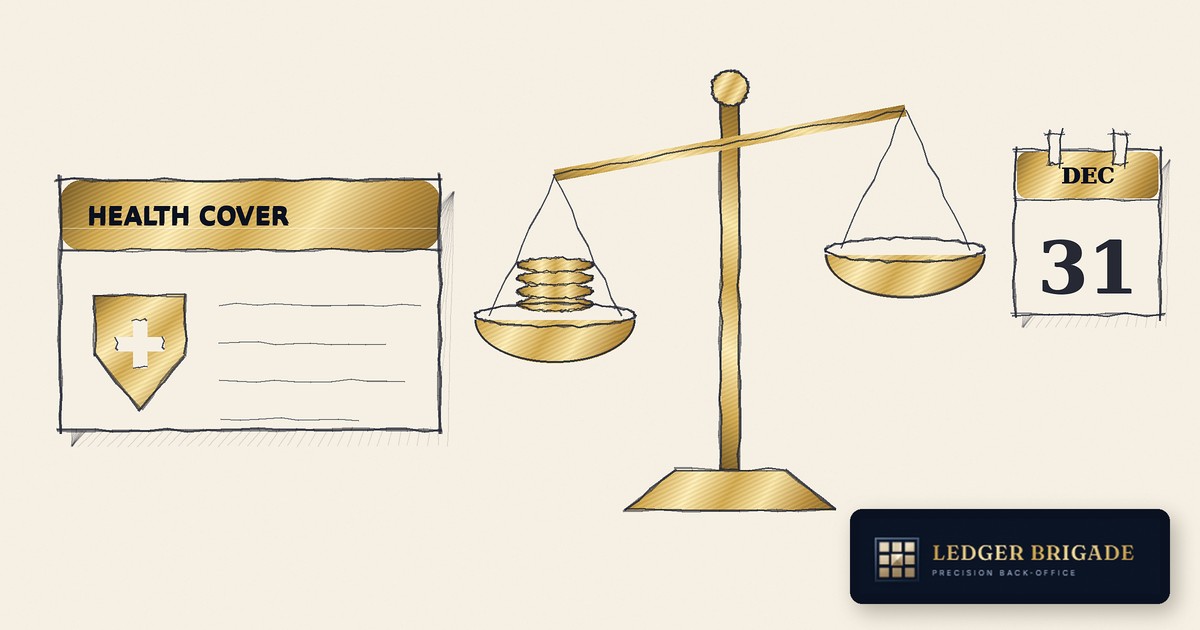
If you run your own business and buy health insurance through HealthCare.gov or a state marketplace, there's a change you need to plan for this quarter. From the 2026 tax year, there is no limit on how much excess advance premium tax credit you may have to repay when you file your return.
Congress made the change in the One Big Beautiful Bill Act (Public Law 119-21) in 2025. On October 14, 2026, Treasury and the IRS proposed regulations to implement it, and they were published in the Federal Register on October 15. Open enrollment for 2027 coverage starts on November 1, so now is a good time to look at both years together.
What changed
The premium tax credit lowers the cost of marketplace coverage. Most people take it in advance: the marketplace estimates your income for the year and sends a monthly credit straight to your insurer. When you file your return, Form 8962 compares that advance credit with the credit you actually qualified for, based on your real income.
If your income came in higher than you estimated, you received too much credit. Until 2025, the repayment was capped for anyone below 400% of the federal poverty line. For 2025 returns the caps ran from $375 to $1,625 for single filers and from $750 to $3,250 for other filers.
From tax years beginning after December 31, 2025, those caps no longer apply. Section 71305 of P.L. 119-21 removed them, and the proposed regulations confirm it. Every dollar of excess advance credit is added to your tax bill.
Three other points matter:
- The enhanced subsidies expired at the end of 2025. They have not been renewed. A House-passed extension stalled in the Senate, and no extension had been enacted at the time of writing. So the hard 400% cliff is back: above 400% of the poverty line, there is no credit at all.
- Income-based special enrollment periods no longer qualify. The law excludes plans picked during an income-based special enrollment period from premium tax credit eligibility, for plan years beginning after December 31, 2025. Don't count on enrolling mid-year with a subsidy. Use open enrollment.
- Eligibility rules tighten from 2027. Under the law and the proposed rules, certain lawfully present noncitizens will no longer qualify for the credit from 2027, and new pre-enrollment verification requirements follow from 2028. If this could affect you, check your eligibility before you renew.
The regulations are proposed, not final. Comments are due November 30, 2026, and a telephone hearing is scheduled for December 8, 2026. The cap removal itself is already law, though, so it applies to your 2026 return whatever happens to the regulations.
The numbers at a glance
| Item | 2026 coverage | 2027 coverage |
|---|---|---|
| Repayment cap on excess advance credit | None (repealed) | None |
| Poverty guidelines used (1 person / 4 people, 48 states + DC) | 2025: $15,650 / $32,150 | 2026: $15,960 / $33,000 |
| 400% of poverty line: no credit above this (1 person / 4 people) | $62,600 / $128,600 | $63,840 / $132,000 |
| Applicable percentage range (share of income you pay toward the benchmark plan) | 2.10% to 9.96% | 2.15% to 10.22% |
| Employer "affordability" percentage | 9.96% | 10.22% |
| Open enrollment (HealthCare.gov) | Closed | Nov 1, 2026 to Jan 15, 2027 (pick by Dec 15 for a Jan 1 start) |
State-run marketplaces set their own dates, so check yours.
What it means for business owners
Salaried employees can usually estimate their income accurately. Business owners can't. One large invoice, a strong December, an asset sale or a year-end S corporation distribution can move your household income a long way from the estimate you gave the marketplace last November.
Under the old rules, the cap limited the damage. From 2026, the full gap shows up as extra tax next April. If your income crosses 400% of the poverty line, you lose the whole credit for the year and repay every advance dollar.
Worked examples
These examples are illustrative. They assume a single filer with full-year coverage in a 48-state marketplace and a benchmark plan of $7,200 a year ($600 a month), using the 2026 percentages and 2025 poverty guidelines. Your actual figures depend on your plan, location and household.
Example 1: income higher than expected, but under 400%. Maya, a freelance designer, estimated $35,000 of 2026 income when she enrolled. That's about 224% of the poverty line, so she was expected to contribute about 7.47% of her income, or $2,615. Her advance credit came to about $4,585 for the year. Her actual income ends up at $55,000, about 351%. Her expected contribution rises to 9.96%, or $5,478, so the credit she actually qualifies for is about $1,722.
- Excess advance credit: about $2,863
- Under 2025 rules she would have repaid at most $1,625
- For 2026 she repays the full $2,863, about $1,238 more
Example 2: crossing the cliff. Same facts, but Maya's income lands at $65,000, which is above $62,600. She qualifies for no credit, so she repays all $4,585. Suppose instead she makes a $3,000 deductible contribution to a SEP-IRA or solo 401(k) that brings her modified AGI down to $62,000, just under the line. She would then qualify for about $1,025 of credit, and her repayment would fall to about $3,560. On top of that, she keeps the income tax saving on the contribution.
(Example 2 is simplified. The self-employed health insurance deduction and the premium tax credit affect each other, and IRS Publication 974 sets out how to calculate both together.)
Action checklist
- Update your 2026 income estimate now. Log in to your marketplace account and report your realistic full-year income. A lower advance credit for November and December means a smaller bill in April.
- Run a year-end projection. Look at your income for January to October, then add expected invoices, bonuses, distributions and any gains from selling assets.
- Check where you are against 400% of the poverty line. If you're close, consider deductible retirement contributions. If you already have a solo 401(k), make your 2026 employee-deferral election by December 31. A sole proprietor opening a new solo 401(k) can, under SECURE 2.0, adopt it as late as the 2026 return due date (without extensions) and still make deferrals for 2026. SEP-IRA contributions can usually wait until your filing deadline, including extensions.
- Cover the gap. Set aside cash, or increase your January 15, 2027 estimated payment, so a repayment doesn't come with an underpayment penalty.
- Enroll on purpose for 2027. Use the 2026 poverty guidelines and the 10.22% top percentage when you estimate your 2027 income. Pick a plan by December 15 if you want coverage from January 1.
- S corporation owners: If the company pays your premiums, make sure they're reported in Box 1 of your W-2. You need that to claim the self-employed health insurance deduction.
Frequently asked questions
Does this affect my 2025 return? No. The 2025 caps still apply to 2025 coverage. The repeal starts with tax years beginning after December 31, 2025.
The regulations are only proposed. Can I wait? The cap removal is in the statute itself, so it applies to 2026 returns whether or not the regulations are finalized.
Can I claim both the self-employed health insurance deduction and the credit? Yes, but not for the same dollars. Together, the deduction and the credit can't be more than the premiums you paid. Publication 974 explains the calculation.
I'm a small employer. Does anything change for me? If you have 50 or more full-time-equivalent employees, the 2027 affordability test uses 10.22% (up from 9.96%). If you offer an ICHRA or QSEHRA, review how it interacts with your employees' eligibility for the credit before renewal.
Talk to us
Not sure where your 2026 income will land, or how your business structure affects it? Email hello@ledgerbrigade.com or book a free diagnostic call. We'll help you get your books current so you can make year-end decisions on real numbers. The call is general guidance only, not preparation or review of a tax return.
Disclaimer: This article is general information, not tax or legal advice. The October 2026 regulations are proposed and may change. Premium tax credit results depend on household size, location, plan prices and other facts. Talk to a qualified tax professional before acting.
Sources
- IRS, IR-2026-121: irs.gov
- Federal Register, Premium Tax Credit proposed rule (2026-21056): federalregister.gov
- IRS, Rev. Proc. 2026-26 (2027 percentages): irs.gov
- IRS, Rev. Proc. 2025-25 in IRB 2025-32 (2026 percentages): irs.gov
- HHS 2026 poverty guidelines (Federal Register): federalregister.gov
- HealthCare.gov dates and deadlines: healthcare.gov
- KFF, repayment limits: kff.org
Comments (0)
Be the first to comment.
Leave a comment